Openscreen Atlas re-imagines asset management with a field-first, asset-centric approach. Field staff get simple, intuitive and asset-specific workflows, and assets are twinned with tags that give them true intelligence. The foundation is a no-code platform with overlays and plug-ins by industry and module. The result? Faster resolution, higher adoption, improved compliance, uptime and efficiency.
Atlas turns any asset into an interactive experience in a few straightforward, configurable steps. Here are the four that form the backbone.
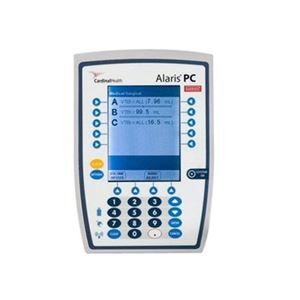
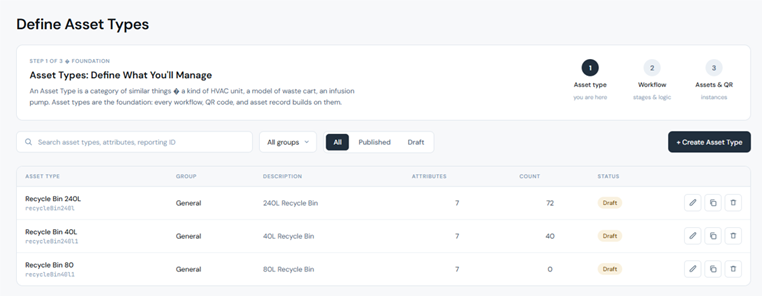
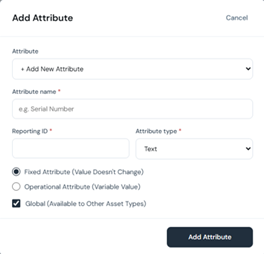
An Asset Type is a blueprint for a class of asset — a model of waste cart, a type of pump, a category of router — with its own fixed attributes (serial number, manufacturer, install date) and operational attributes.
Every workflow, QR code, and asset record builds on this foundation.
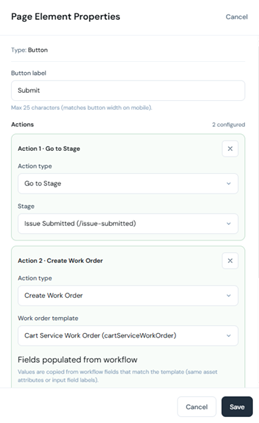
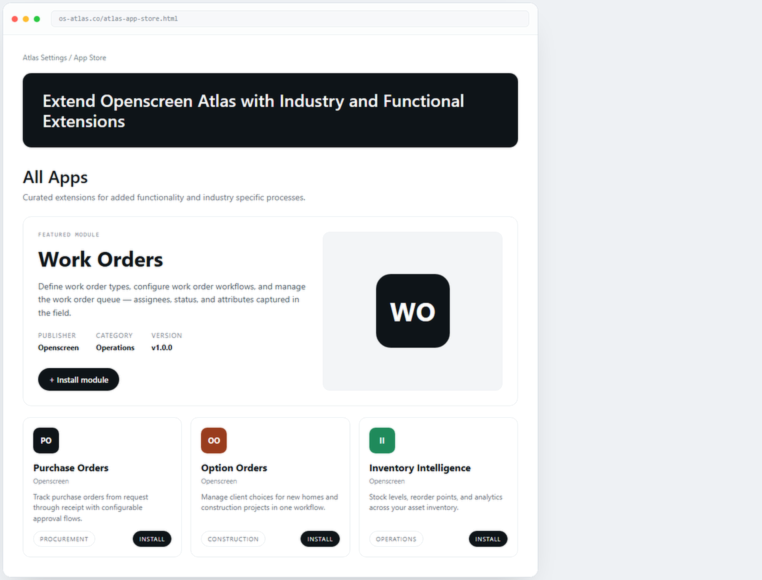
Configure reusable work order templates with the exact elements your teams need — form fields, status flows, and button actions that drive the work forward.
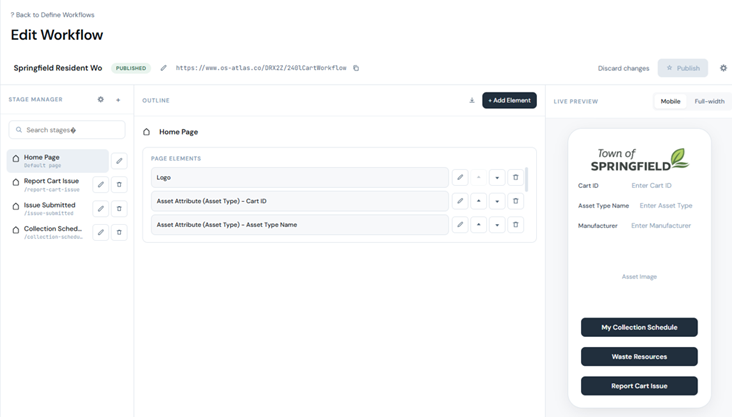
Define once, apply everywhere. The same page-element editor powers templates and workflows alike, with a live mobile preview as you build.
A Workflow is a process twinned to an asset — represented by an asset-specific URL and triggered by a QR scan. Using a no-code editor, you assemble multi-stage experiences with page elements, properties, and button actions.
Button actions go further than forms: Go to Stage, Send Email, or Create Work Order — with fields auto-populated from the workflow into the matching template.
Create individual asset instances at scale — manually or by CSV — and link each one to its workflow. Every instance receives its own unique, serialized QR identity: the bridge between the physical object and its digital twin.
Because each QR is unique to its asset, scanning loads that asset's details automatically — field users never re-enter what the platform already knows.
Raise work orders against any asset instance from the admin console, with asset details pre-populated. Track, update, and close through the full lifecycle.
Anyone who scans lands on the asset's workflow with details already loaded. A resident reports a damaged cart; a technician logs an inspection — in seconds, from a phone.
Activity flows into structured reporting — a real-time, portfolio-wide view of every asset, every interaction, and every open work order.
Asset management shifts from periodic and reactive to continuous and intelligent — driven by interaction at the point of interaction.
Every asset carries a unique, serialized QR that resolves instantly to its own digital experience — no app, no login for field users.
Define asset classes and their attributes — fixed and operational — through a configuration UI. No schema migrations, no engineering.
Assemble multi-stage, asset-specific workflows with configurable page elements and button actions. Configure once; every instance inherits it.
Because each QR is unique to its asset, scanning loads that asset's details automatically — users never re-enter what Atlas knows.
Create, assign, update, and close work orders against any asset instance, with templates that standardize how work gets done.
Spin up thousands of asset instances and link them to workflows in a single motion — ready to tag, deploy, and scan.
A live, structured view across the entire portfolio — activity, status, and open work orders, all in one place.
Enterprise-grade tenancy isolation with platform admin users and workflow users — the right people get the right access.
From bins to broadband — schema-flexible types and configurable workflows serve every asset class on a single platform.
Field teams capture and act on asset data in the moment — at the point of interaction — instead of returning to a desk to update a back-office system.
Atlas extends asset interaction beyond the maintenance team to everyone who touches the asset — employees, contractors, residents, customers.
No-code configuration replaces lengthy, six-figure CMMS implementations. Define your types and workflows, generate assets, and go live.
Schema-flexible types and configurable workflows let a single platform serve facilities, healthcare, telecom, municipal, and more.
Continuous field interaction feeds a real-time portfolio view, shifting asset management from periodic and reactive to continuous and intelligent.
With mobile enablement and intelligence at the point of interaction, Atlas transforms asset management from a cost center into a differentiator.